







The Heart of Manly Heritage Walk
|
|
|
IntroductionThis walk is a part of Manly's heritage strategy. Along the way you will discover our Heritage Plaques which identify and inform you of places of special interest. |
|
Heart of Manly Heritage WalkThe Heart of Manly Heritage Walk begins at Manly Wharf. But you can start the walk at any point. The Heart of Manly Heritage Walk is devised as in a clockwise direction, circumnavigating The Corso. |
|
Ivanhoe ParkManly's history is unique. It is a place synonymous with the leisure pursuits of Australians of all ages. Since the introduction of a ferry service to Manly Cove in the 1850s, Manly has undergone many changes in its built environment. |
|
South Steyne and the BeachThe Heart of Manly, will take you on a conducted tour of the locality known to residents as 'the flat'. From the earliest days, the flat of Manly, that strip of land between the harbour, hills and the ocean, has been the focus of visitors, residents & businesses. |
|
Broken Column MemorialEnjoy The Heart of Manly Heritage Walk and let the history of Manly tell you a story of the people and places that together have created the myth and magic of Manly. |
|
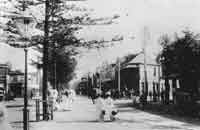
The Heart of Manly Heritage Walk was researched, developed AND written BY a community committee of Manly Council. Members of the Heritage Walks sub-committee include; Cr Sue Sacker - Chair, Cr Nancy Burridge, Ms Jean Allan, Ms Virginia MacLeod, Mr Ken Muir, Ms Joan Patrick, Ms Judy Reizes, Ms Maureen Smith. The Heritage Walk Subcommittee Wishes TO extend its very great appreciation TO those community members AND organisations who have contributed TO the research of the walk: Manly Art Gallery & Museum, Ian Hayes - Conservation Consultant -NATIONAL Trust of Australia, Mary White, Custom Mapping Services. Line Drawings BY Leith Nicholson AND Shannon McIntyre-Crees. ©1995 Copyright Manly Council.
Top | Walks Menu | Visitor Info Menu
Introduction
In January 1788, Captain Arthur Phillip, in his first voyage of exploration, sailed into Port Jackson and encountered a band of Aboriginal men, whose manly physique was cause for compliment and record. The sandy cove on which they stood has preserved the name Manly, and with it a reminder of the successful culture and society of the first Australians.
Manly's history is unique. It is a place synonymous with the leisure pursuits of Australians of all ages. Since the introduction of a ferry service to Manly Cove in the 1850s, Manly has undergone many changes in its built environment. Change is a continuing feature of this vital and colourful seaside locality. Fortunately, many fascinating and delightful structures, parks, buildings and plantings remain to tell us of the visions that successive generations of Australians have pursued to make Manly the jewel in the crown of metropolitan Sydney.
Manly Council, in association with the Department of Planning, NSW Government, is developing a series of informative and entertaining Heritage Walks to assist the community to appreciate Manly's history. This walk, The Heart of Manly, will take you on a conducted tour of the locality known to residents as 'the flat'. From the earliest days, the flat of Manly, that strip of land between the harbour, hills and the ocean, has been the focus of visitors, residents and businesses. It is Manly's history in essence.
In the years ahead, new Heritage Walks will be developed, branching out from the heart of Manly, to take visitors to the splendid harbour beaches and walks and localities of high conservation value. The Heart of Manly Heritage Walk is the result of the outstanding commitment of local historians and community representatives. Under the guiding hand of Councillor Sue Sacker, a team of heritage experts was convened to ensure that this trail provides a colourful and accurate insight into Manly.
This project has been made possible through the financial support of the Heritage Branch, Department of Planning, NSW Government, and Manly Council. Enjoy The Heart of Manly Heritage Walk and let the history of Manly tell you a story of the people and places that together have created the myth and magic of Manly.
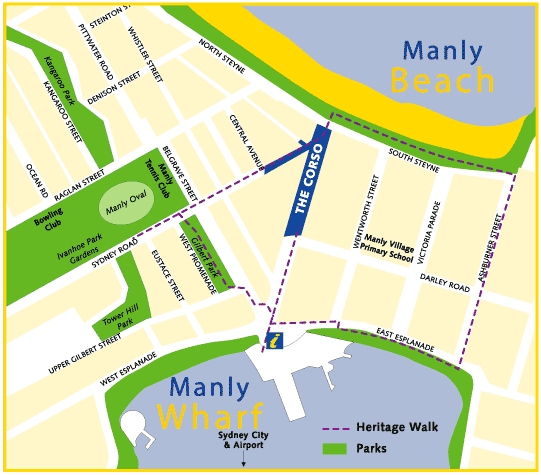 Hertitage Walk Map
Top | Walks Menu | Visitor Info Menu
There are no markers on the streets and promenades. But don't be concerned, the streets of Manly are clearly identified. Be adventurous, take your own diversions, sit and have a coffee if the mood takes you, and rejoin the walk refreshed.
 This walk is a part of Manly's heritage strategy. Along the way you will discover our Heritage Plaques which identify and inform you of places of special interest.
The Heart of Manly Heritage Walk begins at Manly Wharf. But you can start the walk at any point. Look for the bold headings in the text to help you find the information that matches your location.
The Heart of Manly Heritage Walk is devised as in a clockwise direction, circumnavigating The Corso. Once you have finished the walk discover one of Sydney's busiest and most colourful places, The Corso.
Enjoy the Heart of Manly Heritage Walk and discover why Manly is unique.
Top | Walks Menu | Visitor Info Menu
The Heart of Manly Heritage Walk
 Begin your exploration of Manly at the point at which most people have started their visits over the last 200 years since Europeans settled here. For thousands of years before that Aboriginal people roamed this coastal area hunting, gathering and fishing. There were two local clans, the Cannalgal and the Kayimai. They made huts from bark, branches and driftwood or sheltered in caves and under rock ledges. They shared a close relationship with their surroundings and the creatures of the land and sea, illustrated by rock carvings. Regrettably there is little known evidence about their lives in this area before European settlement.
There was little European settlement in Manly during the first half of the nineteenth century, partly because it was remote from Sydney, but also because the land was unsuitable for agriculture. However, this did not deter Henry Gilbert Smith. In 1853 he bought some land in the area with the vision of Manly, with its splendid ocean beach and sheltered sandy coves, becoming "the favourite resort of the Colonists".
In 1855 Smith built the first Manly wharf, and soon after an intermittent ferry service started, used mainly by day trippers. Four years later he purchased shares in the paddle steamer Phantom, sometimes called Puffing Billy, and the first regular service began. The timetable advertised a 30 minute trip but in rough weather it could take an hour or more. Phantom could carry 166 passengers, whose only protection from the weather was a canvas awning stretched over the single deck.
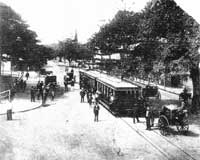
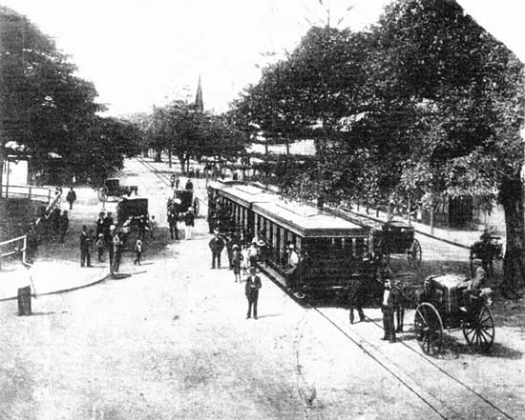 Stream Train at Corso
In the early 1860s if there were sufficient theatre-goers and others wanting to travel to the city in the evening, Phantom sailed to Sydney about 7pm and waited there to make the return trip. With engineer Robert Grant as super- intendent, those arriving well before the 11pm departure roasted potatoes in Phantom's boiler furnaces. Whisky, coffee and baked potatoes made a supper that everyone could enjoy on the journey home. This gathering was known as the Hot Potato Club.
For nearly a century the Port Jackson Company developed and operated the ferry service. In 1972 it was taken over by Brambles Industries and two years later by the New South Wales Government. Hydrofoils were introduced in the 1960s, halving the time for the trip. They proved to be unreliable and costly to maintain and in 1990 were superseded by jetcats, which could transport many more passengers on each trip. The ferry service continues to be popular and transports commuters and millions of visitors to and from Manly every year across Sydney's magnificent harbour.
Top | Walks Menu | Visitor Info Menu
Leave the ferry terminal by its front entrance and cross to The Corso
The Corso links Manly Cove with the ocean beach. An existing track was widened by Henry Gilbert Smith in 1855 and named after a major street in Rome. Manly Council's original planting of Norfolk Island and Monterey pines and Moreton Bay and Port Jackson fig trees have been replaced by palms at this end of The Corso.
Transport by tram was introduced into Sydney in the early 1880s. There was a local demand for trams from the 1890s, but it was not until 1903 that the first line in Manly opened. The route went from West Esplanade, down The Corso along North Steyne turning into Pittwater Road at Carlton Street and continued to the terminus near Manly lagoon.

This building which still stands has been incorporated into a car show room at the junction of Pittwater and Balgowlah Roads. The first trams were steam-powered but replaced by horsedrawn ones when passenger numbers declined. Steam trams were reintroduced in 1907 and later electric trams were used. The line was extended in stages to reach Narrabeen by 1913, but the plan to take the tram to Pittwater was never realised. In 1911 a single tramline was opened between Manly and the Spit. Until the first Spit Bridge was opened in 1924, travellers crossed the water by punt before joining another tram. When buses replaced the trams, a mock funeral service was held to farewell the last tram as it left Manly Wharf about 1.30am Sunday I October 1939. A wreath was placed on the front of the tram which, draped in black, travelled to the depot accompanied by the muffled beat of two drums. However the mood was not sombre as the crowd of passengers and followers sang such songs as 'Pack Up Your Troubles' and 'Auld Lang Syne'.
On the corner of West Esplanade and Belgrave Street once stood the Pier Hotel, one of the first of Henry Gilbert Smith's buildings in Manly, constructed the same year as the wharf. It later became known as the Grand Pier Hotel. The building was demolished to make way for the Hotel Manly, completed in 1926. An Art Deco tower was added to the hotel in 1935. Art Deco was a decorative style of the 1920s and 30s using geometrical shapes and Egyptian and Greek motifs. A statue of Captain Phillip by sculptor Raynor Hoff was set in a niche in the tower facing The Corso. Raynor Hoff also created the sculptures on the Anzac Memorial in Sydney's Hyde Park. In 1989 the Hotel Manly was demolished and the statue will be a feature of the new apartments and shops to be completed in 1995. '
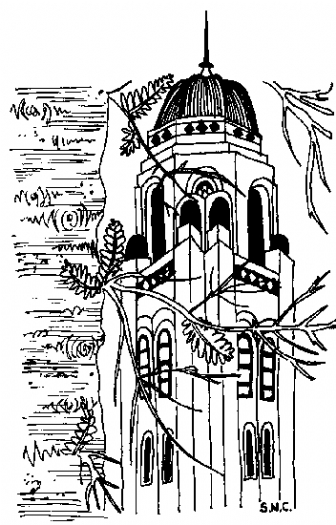 Uniting Church
Manly Council was incorporated in 1877. The present Town Hall, designed by local firm Trenchard Smith & Maisey, opened in 1937 to mark Council's 60th anniversary. The columns are decorated in the Egyptian Revival style. The discovery of Tutankhamen's tomb in 1922 attracted world-wide interest and led to the revival of Egyptian themes in architecture. Another example of this style are the pylons of Sydney Harbour Bridge.
Cross The Corso and Belgrave Street to Gilbert Park
Originally twice as long extending as far as Raglan Street, the park formed a central feature of Henry Gilbert Smith's design for Manly. The tennis courts cover what was the northern section of the park. Henry Gilbert Smith. Between 1979-1981 both the police station and the courthouse were extensively renovated, and further alterations to the courthouse in 1993 uncovered an old sandstone well.
The aviary, built in 1977 in Gilbert Park, has become a sanctuary for injured Rainbow lorikeets. For several years, it was a free-flight aviary where they could come and go as they pleased.
The Caley Lorikeet Trust was established in 1985 to manage the shelter. Wild lorikeets use the Manly pines for roosting, and leave at daybreak to feed on nectar, fruits and seeds. They also visit people's homes but unfortunately many have suffered fatal illnesses caused by inappropriate feeding.
Top | Walks Menu | Visitor Info Menu
Cross Sydney Road to the entrance of Ivanhoe Park
Across the oval can be seen St Andrew's Presbyterian church which was opened in 1890. This Romanesque style building, with its commanding bell-tower, was designed by John Sulman. In 1884 the first Presbyterian services in Manly were held at Fernbank, West Esplanade, the home of C.H. Hayes, Mayor of Manly.
Climb Sydney Road as far as the Tony Miller grandstand
On the opposite side of the road a high sandstone wall is surmounted by two gargoyles. This is all that remains of the residence Marinella, commonly known as Dalley's Castle. It was built in 1881 by William Bede Dalley, lawyer and statesman. His wife, Eleanor Jane, died of typhoid when it was being built and Dalley himself only lived there for about three years. For many years it was owned by the McGaw family, but for a decade it was unoccupied and became dilapidated. Then in 1932 the Rev. C.H. Palmer purchased it and with renovations and extensions it became the Camden Grammar School. In 1939 this towering landmark was demolished and the existing flats, also named Marinella, were built.
 Manly's first wild flower shows were held in Ivanhoe Park. Native flora used to grow in abundance around Manly including Christmas bush which was used to decorate church pews and shop fronts at Christmas. Alderman C.H.Hayes initiated the first Manly Wild Rower Show in 1881 to raise funds for the extension of St Matthew's church. It was held in the Ivanhoe Park pavilion, an old weatherboard construction with an iron roof. A canvas annexe housed orchids and ferns. The first show was for one Saturday afternoon only, but it became very popular and for about a decade it was an annual event lasting for several days. Stalls were decorated with beautiful bouquets and impressive floral representations of the British crown, hearts, harps, lakes and ships. On occasion children entertained visitors with Maypole dancing. At night the grounds were illuminated with Chinese lanterns.
Top | Walks Menu | Visitor Info Menu
Walk east along Sydney Road crossing Belgrave Street to Whistler Street
For some months in 1902 famous writer and poet, Henry Lawson and his wife Bertha, rented the dwellings Marlow and then Ladywood, both in Whistler Street. They were married in 1896 and had two young children. Henry Lawson wrote several poems about Manly, including 'The Cliffs', 'The Stranded Ship'- about the Vincennes, a barque that went aground at North Steyne - and 'The Bards Who Lived at Manly' which illustrates this period of his life. (This poem is reproduced on plaque 4). Bertha recognised his genius, but his frequent drinking bouts with bohemian friends and his inability to support his family led her to seek a legal separation in 1903.
The oldest existing ecclesiastical building in Manly is the Gothic Revival style Congregational church. It was built in 1862 in sandstone with an attractive timber interior. The original stained glass is still in good condition but the slate roof has been replaced with concrete tiles. Two trustees of this church John Fairfax and David Jones were founders of important Sydney institutions. Fairfax was the first proprietor of the Sydney Morning Herald and David Jones started the chain of retail stores which bear his name. The foundation stone of the adjoining church hall was laid by Sir James R. Fairfax in 1907. Before this church was built services were originally held in the house of John Trenchard Smith at the comer of The Corso and East Esplanade. .
Continue along Sydney Road and glance to the left along Short Street
St Mary's Roman Catholic church is glimpsed at the end of Short Street. The nave of this church was built in the early 1890s and additions were made in 1909. On the right is Roycroft Arcade leading to Market Place, and Manly's new library designed by Feiko Bouman, renowned Sydney architect also responsible for the prizewinning Stockman's Hall of Fame in Queensland. In 1989 this end of Sydney Road was closed to traffic and made into a pedestrian mall, linking it with The Corso.
Here are the offices of the Manly Daily newspaper founded by Edward Lincoln. The first issue, a single folded page, came out on 28 July 1906. Apart from the first few months when it was printed in Sydney the Manly Daily was produced in Manly, but in 1989 production and printing moved to the headquarters of its proprietors the Cumberland Group in Parramatta. It was the first free newspaper to be published in New South Wales, and remains the only one to be published five days a week. Its growth has mirrored the development of Manly.
 The changing use of buildings reflects the needs of the community they serve. In 1916 Pacific Point was a cinema called the Britannia. It was renamed the Olympic in honour of Manly's champions: Boy Charlton, Dick Eve and Nick Winter, gold medallists in 1924 at the Paris Olympics. In 1934 as the New Olympic it was a venue for vaudeville theatre. Dobbs Bros. converted the building into a furniture store in about 1936. In the post-war economic boom of the 1950s Waltons Ltd bought the site and opened their furniture and home appliances store on 3 December 1954. In the 1970s the building was converted into offices and an auction room. The shops and arcade linking Sydney Road with Henrietta Lane were constructed in 1983.
Pause by the sculpture Wind and Wave at the junction of Sydney Road and The Corso
Made of stainless steel, it is the work of distinguished Melbourne sculptor, Lenton Parr, noted for his works in welded steel. It was funded by the State government as part of a Bicentennial grant to Manly in 1988. The sculpture captures the essence of Manly's ocean beach. The Bicentennial project also included the construction of the Sydney Road Plaza.
Look above the awnings at the shop fronts which feature circular windows and elaborate decorations including garlands and ribbons, in the Art Nouveau style. This international style of art, popular from the 1890s to 1914, emphasised asymmetrical forms of nature.
Top | Walks Menu | Visitor Info Menu
Cross the road to South Steyne and the beach
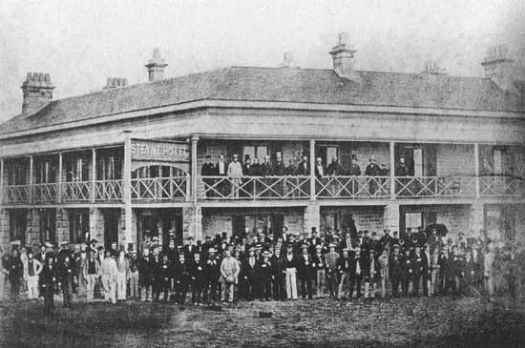 1st Steyne HotelThe photograph shows the first Steyne Hotel at the junction of The Corso and North Steyne, built by Henry Gilbert Smith in 1859. It has been rebuilt and renovated over the years, once having been destroyed by a fire. The present hotel was built in 1935 at a cost of 25,000.
Manly beaches have existed in their present form for the last 6,000 years, during which time sea level has been more or less stable. Sand carried here by onshore currents accumulated on the rocky bar that connects the higher ground of North Head, Queenscliff and Fairlight. Pre-historic Manly was very different. About 126,000 years ago the sea level was higher than it is today. The valley between Shelly beach and Queenscliff was beneath the sea, which penetrated far inland to Brookvale. In contrast, more recently, about 20,000 and 16,000 years ago, sea level was at times 120 metres lower than it is today. The continental shelf was exposed and the shore was about six kilometres further east. There was a broad strip of grass and scrub- covered coastal plain, with lagoons mid estuaries, which is now submerged.
Top | Walks Menu | Visitor Info Menu
Walk along South Steyne
On the hill in the distance is St Patrick's College, built as a Roman Catholic seminary in 1889. Manly has had a reputation as a health resort for many years. In 1873, Dr William O'Reilly, writing about Manly in the New South Wales Medical Gazette, urged the medical profession to consider the 'locality's sanitary importance and advantages as a convalescent station ... any professional gentleman has only to visit Manly once to become aware of the fact that it offers special inducements to those suffering from liver complaints and chronic infections of the digestive organs...' At the beginning of this century newspapers wrote of Manly as 'the Watering Place of the Nation' and the 'Brighton of the South' referring to it as place for recuperation and relaxation.
 Opposite the beach stands the Royal Far West Children's Home. Family life in outback NSW was tough when Methodist pastor, Stanley Drummond, and his wife Lucy cast about for a remedy to relieve those who suffered most. Sea breezes and good food were the tonic they chose. In 1925 they brought a group of 58 children and six mothers to the coast for the first in a series of visits that became an annual event. The children they selected were physically disabled, malnourished and debilitated by the heat, dust and flies. The Drummonds' legacy has continued. This important organisation today still provides all country children with accommodation and education while they receive medical treatment.
Local legend has it that the planting of Manly's Norfolk Island pines, Araucaria Heterophylla, was begun by Henry Gilbert Smith. Over 500 trees flourished for almost a century until nearly half were damaged or destroyed in the 1960s by airborne pollution from the North Head sewage outfall. Rock star and environmentalist, Peter Garrett, planted the first new pine at South Steyne in 1991.
Subsequently 85 new trees were planted to begin the reconstruction of the crescent of pines along the length of the oceanfront. The National Estate listing of the pines and promenade was celebrated together with the first stage of Manly Council's replanting programme. Manly's success in providing welcome shade in these harsh seaside conditions was to provide a model for similar planting elsewhere in Australia.
 In the block between Victoria Parade and Ashburner Street stands a building named Dungowan. Wealthy pastoralist and company director Leslie Sprague built Dungowan Flats in 1919 naming them after his country property Dungowan Station, 33 kilometres east of Tamworth. The Flats offered their privileged tenants a home with 'every modern convenience' 'fully supplied with electricity, telephones and an 'electric elevator'.
A commercial kitchen on the ground floor serviced the Restaurant De Luxe above. In 1925 the company Dungowan Ltd converted the Paramount Picture Theatre next door into the Cabaret Dungowan where grand social occasions were celebrated. An ice skating rink was added at the end of the 1920s, creating a complex of buildings extending to the corner of Ashburner Street and South Steyne.
In 1908 the Sydney Morning Herald described Manly as, 'The Boulogne of Australia...it has been a common thing for 20,000 to 30, 000 people to go over to Manly on a single afternoon...long lines of dressing sheds have been put up for them [surfbathers] under the seawall. The long curved avenue of Norfolk Island Pines, which is the hallmark of Manly is nothing except Australian. But the ocean beach itself might belong to the north coast of France...the long line off hire chairs, with standing parasols and many coloured skirts peeping over the edges of them, a bunch of drowsy saddled ponies, the donkeys and side shows, miniature railways... entertain the crowd of bathers'.
Manly is historically important in the introduction of daylight swimming, recreational beach culture, surf lifesaving, and board surfing into Australian culture. Here Tommy Tanna, a native of Talma Island in Vanuatu, taught 16-year-old Fred Williams to body surf at South Steyne in 1891 beginning the popularisation of surf bathing. Daylight bathing was illegal until local newspaper proprietor William Gocher campaigned successfully to change Manly Council's by-law. When legislation was introduced to permit bathing in daylight hours in 1903 the Manly community began campaigning for an organised surf rescue service. On Boxing Day that year, Eddie and Joe Sly, their fishing boat adapted for surf rescues, staged a carnival demonstrating a variety of rescue techniques.
In July 1907 the Manly Surf Club held its inaugural meeting. Three months later the State co-ordinating body, the New South Wales Surf Bathing Association, was formed, the forerunner of today's Surf Lifesaving Association of Australia. New Zealander, Happy Eyre, the first lifeguard employed by Manly Council, started work in October 1907. He patrolled at North Steyne on alternate Sundays, with the members of the North Steyne Surf Bathers and Life Saving Club, beginning today's system of close co-operation between professional lifeguards and volunteers.
The culture of the beach fostered an easygoing attitude and a determination to balance endeavour and relaxation which is a feature of the Australian character. It produced a cultural symbol, the bronzed Aussie lifesaver and led to Australia's outstanding record of achievement in water sports.
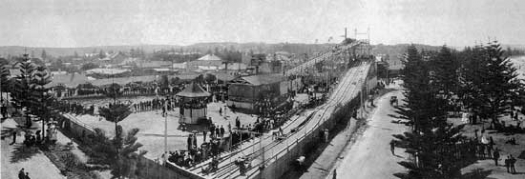
A booklet advertising Steyne Court in 1904 described it as a place of exciting technology and breathtaking adventure. Twenty arc lights, each giving off 2000 candle-power, spread light as bright as day over the grounds. The water chute ride stood 15 metres high and used a winch driven by a 50 horsepower engine to pull a boatload of eight passengers up greased hardwood skids, at an incline of one in three, to the top of the tower. The boat was then re- leased and plunged headlong into an artificial lake at such speed that it skipped along its surface before coming under the control of the steersman who guided it to a landing at the opposite end of the lake. The lake was shaped like a large kite 65m by 25m, its walls made of concrete and brick. It held 48,000 litres of fresh water which was topped up daily from the mains supply.
There was also a fast toboggan ride, with a track of steep slopes and camelback humps. For those who preferred a more sedate pace, the Great Dragon, 'perfectly tame and docile' and powered by a De Dian six horsepower motor inside its head, meandered a trackless route through the grounds. A shooting gallery gave marksmen the opportunity to shoot kangaroo and other wild animals.
The Bijou Theatre entertained audiences with a biotint called 'A Trip to the Moon'. The 32 moon scenes included 'photographs' of its inhabitants. Audiences found 'weirdly delightful' ... 'A beautiful Electrical Transformation Cloak Effect Act'. Entertainments described as 'the latest successes from London and American theatres' were on the Bijou's schedule, with four daily performances. In the background an orchestra played day and night from a gaily illuminated band stand. At the gypsy tea rooms waitresses in Swiss costume served ices, ice creams, fruit salads, cakes and fancy pastries; and at the kiosk patrons could buy a glass of wine. Family parties were catered for at any time and supper parties could be catered for by arrangement. The grounds were enclosed by a 4 metre high fence that was decorated by land-scape artist, Ray Phillips. Steyne Court covered one and a half acres of land between Wentworth and Ashburner Streets. It opened daily from 2.30 to 10pm and on holidays, 11am to 10pm. Admission was 6d for adults and 3d for children.
Top | Walks Menu | Visitor Info Menu
Turn from the ocean and walk toward the harbour along Ashburner Street
Landowner, Katherine Darley/Bassett, nee Wentworth, and her son-in-law, Francis James Ashburner were only two of the many who endowed Manly's streets with their names in the 19th century.
Notice the iron plaque bolted to the rock face marking the start of work in 1898 on major improvements to Manly's sewage disposal system. The Manly Grammar School for Girls is commemorated nearby on another plaque, which was unveiled on 20 June 1994 by former students of the school. The Latin motto means 'Manners maketh man'.
 Ashburner Street contains a variety of architectural styles ranging from the Victorian era to the most recent, the south tower of The Kestrel, on the corner of Dungowan Lane, which opened in 1989.
The oldest blocks of flats, erected during Manly's building boom in the 1920s and 30s, are nos. 43, 41, 39-37, and opposite no. 34, Rowena and no. 30, Winchelsea. The domestic style of Gallipoli Flats no. 43 and The Astor no. 41, differ remarkably from The Checkers next door. Its entrance, marked by grand columns and terrazzo stairs inlaid with the building's name, creates an image of material success and symbolises the optimism of investors - a reminder that not everyone lost money in the Great Depression. Valentia at no. 33 was built about 1918. The horizontal lines decorating the facade, repeated in the house number, the verandah steps, and front fence, are precursor to the Art Deco style of the 1930s.
The cottages at nos. 20 and 18 are Victorian Italianate in style, featuring ornate timber fascias, and cast iron columns and valances. Across the road the three cottages nos. 23, 21, and 19 and 23, and no.10 opposite, were built just after world War I. The absence of ornamentation, noticeable where the houses retain heir original appearance, indicates that they were typical workers cottages of his period. Nos. 16 and 14 are also workers cottages built in the mid 1920s. Their rick entrances, stained glass, and intricately carved verandah brackets indicate that they were built in a time of greater prosperity.
A small two-storied building at no. 15A was built in the 1870s. It has a pressed metal skirt beneath its bay window, and its brick sidewall is rendered and scored to imitate sandstone. In the 1890s there was a timber merchant and coal and fuel depot here, whose delivery carts loaded in the yard behind the double gates.
8A Ashburner Street is particularly interesting because the folding doors that now form part of the street wall once opened daily onto the footpath. They are a remnant of the industry that operated from this combined factory and residence. In 1895, cordial manufacturer, H.E. Stevenson, lived here and later, Sanders and Co., carriers. The entrance to the residence is set back from the street, giving privacy to the family who lived there.
Facing Darley Road is a Victorian terrace with a Spanish Mission facade, added some 50 years later. This was one of the ways owners updated their properties.
Top | Walks Menu | Visitor Info Menu
Cross Darley Road using the pedestrian refuge up the hill and return again to Ashburner Street
Adastra, no. 8, is an example of Art Deco architecture. The feature at the top, centre of the building has a waterfall motif, a theme typical of this style.
Set back from the road at no. 2, is Fairlands. Its architectural style is Victorian Rustic Gothic with contemporary additions. The Mayor of Manly 1897- 98, F.C. Passau built Fairlands in 1885. A plaque on the driveway wall gives a description of Fairlands' history. Opposite Fairlands at nos. 7A and 5 there are two late Victorian terraces typical of high density working class suburbs, such as Glebe or Paddington. The iron lace verandahs provide a decorative facade to the modest building behind.
Ashbumer Street's architecture captures a microcosm of Manly's history. The cottages were the homes of workers and tradespeople who serviced the 19th century mansions built on the hillsides above, and the visitors who stayed here. The flats of the 1920s and 30s and the units of the 1960s and 70s mark Manly's transition from village to dormitory suburb.
Top | Walks Menu | Visitor Info Menu
Cross East Esplanade to the broken column memorial
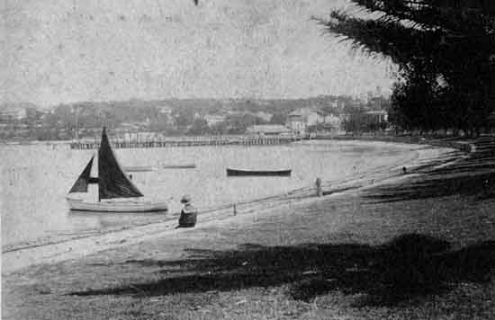 The broken column memorial is a fine piece of Victorian monumental architecture, erected in 1908. The broken column, signifying a life cut off before its natural term, is dedicated to troopers who died fighting in South Africa in 1900; also to F.C. Smalpage who drowned while attempting to save Miss M. Thorpe - a reminder of how close the ocean is in the life of Manly.
Recent excavations revealed a midden, evidence that Aboriginal people used to eat here. They were very skilled at catching fish, which provided the main part of their diet. Using lines, spears or nets, men and women fished from the shore and in canoes. They cooked fish on a small fire aboard their canoes, or on the shore leaving shells and fish bones to be found centuries later.
East Esplanade was the focal point of the Venetian Carnivals. In 1913 for the first occasion 2,000 seats were set up here to view the spectacle. Over the years the carnivals grew, lasting for up to two weeks, and attracting thousands of people. Highlights mentioned in the Sydney Morning Herald in January 1913 included stalls, 'chocolate wheels and other gambling devices', food, costumes, parades and fireworks. The climax was the water pageant, with all the boats and the harbour foreshore decorated with hundreds of Chinese lanterns, flags and streamers. At a time of limited lighting it was remarkable to see 'Manly and its cove..... wrapped in dazzling splendour'.
Walk along East Esplanade towards the wharf
 The Norfolk Island pines here were planted in 1881, in the same year that the sandstone harbour wall was originally constructed. From Manly Council's inception, under its Beautification Scheme, it set out to provide a restful and pleasing atmosphere by planting a variety of large trees. The recent renovations here, improving paths and providing grassy shaded spaces for picnics, continue this tradition.
A cargo wharf once stood next to the ferry terminal. In 1893, a group of Manly residents formed the Manly Co-operative Steam Ferry Company breaking the monopoly of the Port Jackson Company which provided both the passenger and goods service for Manly. The competition reduced fares and increased services. As there were disputes about the use of the wharf the Government took over the wharf from Manly Council and built a second wharf so both companies could operate from here.
However, in 1896, the Manly Cooperative collapsed and thereafter its wharf was used exclusively for cargo. The cargo wharf was of great importance for the first quarter of the century, when cargo was no longer carried on the passenger ferries, but by a separate fleet. The opening of the Spit Bridge in 1924 allowed easier passage of goods by land, consequently water transport decreased dramatically and the cargo wharf ceased operation by 1928. Inter it became a Fun Pier and was replaced by the existing complex in 1989.
The terrace houses, nos. 41 and 42 East Esplanade, two of the earliest buildings of Manly still standing, are best seen from the park. Only the facade remains of these early Gothic Revival terraces built in the 1870s. They were about to be demolished in the early 1990s but protests by residents persuaded Manly Council to save them by refusing demolition consent.
Top | Walks Menu | Visitor Info Menu
Cross by the pedestrian crossing opposite Wentworth Street and return to The Corso
In 1810 Governor Macquarie granted a total of 130 acres to Gilbert Baker and Richard Cheers. The boundaries extended from the southern side of The Corso to St Patrick's Estate. John Thompson's grant of' 100 acres, on the northern side of The Corso, was purchased by Henry Gilbert Smith in 1853 and was quickly developed by him.
D'Arcy Wentworth bought both the Baker and Cheers grants and bequeathed them to his daughter Katherine Darley-Bassett. Henry Gilbert Smith leased this land in the 1850s. Legal complications regarding title prevented its sale until the Bassett-Darley Act of 1877 resolved the situation and the land was subdivided.
A number of late 19th century buildings remain on The Corso although their ground floors have been altered. Many commercial buildings had balconies which not only created extra space but also provided shelter for people on the footpath.
One of the great attractions in Manly last century was the Aquarium which was located approximately on the site of the present Westpac Bank. It was opened on 23 December 1886 by William Bede Dalley. Visitors could view a fine collection of fish, seals and tiger sharks. There was an octopus and an alligator too. The seal cavern and fernery were illuminated by electric light, Manly's latest novelty. The Aquarium was also an entertainment centre where concerts, dances and roller skating could be enjoyed in the grand hall. By 1893 the Aquarium had closed and the building was used to stage Manly's annual Wild Flower Show because the old pavilion in Ivanhoe Park had become too dilapidated.
 Across the street, the words 'Purves Bakery l898' can be read high on the facade. When John Purves opened his bakery he stored his flour in a loft, which was retained when an arcade of shops was built on this site. In 1972 William Orr converted it into a theatre-restaurant called the Music Loft. From 1983 it continued for six more years, under new owner Peter Flanagan, as a theatre-restaurant called Flannos.
Cross Darley Road to St Matthew's Church
The church marks the beginning of The Corso pedestrian plaza, designed by local landscape architect Bruce Mackenzie, opened in 1979. The sandstone St Matthew's church designed by Edmund Blacket, architect of several churches in New South Wales stood on the site of shops nos. 46 to 55. Henry Gilbert Smith laid the foundation stone of the church in 1864. When The Corso was widened to 29 metres in 1877 the church encroached upon the street until it was demolished in 1928. The present church opened two years later on the site of the Victoria Hall. Victoria Hall was built in 1901. It housed the Manly School of Arts later called the Manly Literary Institute. Muff Smith in an interview with the Manly Daily in 1984 recalled that 'at the Vic- every concert, banquet, dramatic show and ball, notably the big three annuals, the hospital, the Masonic and the Catholic, were held there'. Opposite St Matthew's church is the Ivanhoe Hotel, previously known as the Colonnade Hotel. There has been an Ivanhoe Hotel in Manly since 1876. Thomas Adrian built the first in Ivanhoe Park. Alter the hotel moved to The Corso Manly Council held its meetings in the old hotel in the park until 1909 and from then until 1923 the magistrate's court convened there.
 Beyond the polished grey granite and ceramic tiled Commonwealth Bank is a group of 19th century commercial buildings, nos. 41-55. Built in 1870, the row was originally constructed as a symmetrical group of five pairs of which only three remain intact. Pairs of mock Tudor gables in timber and render marked each end of the row. A low-arched gable pediment with two central semi-circular windows is framed by two pairs of small triangular pediments. Only two of the distinctive chimneys have survived.
Opposite, on the corner of Rialto Lane stands the modern shopping complex La Galerie. In the late 1890s this was the site of the merry-go-round owned by Sovereign Smith - so named because he wore gold coins on his jacket and waistcoat. He made enough money from the merry-go-round to buy this block of land. His generosity to local charities made him a legend. He was particularly popular with children for whom he set aside flee-ride days every month in the summer. In 1923 the Rialto cinema opened on this site. It was later renamed the Odeon but closed in 1960.
 This is the end of 'the heritage walk The Heart of Manly.
For further information on Manly's history apply to the local history section at Manly Library and visit the Manly Art Gallery & Museum located in West Esplanade Reserve, Manly Cove, next to Oceanworld.
If you would like refreshment there are numerous hotels and restaurants waiting to serve you in the best of Manly traditions, dating from 1855 when Henry Gilbert Smith first opened the doors of the Pier Hotel.
Heart of Manly Heritage Walk Full Credits:
The Heart of Manly Heritage Walk was researched, developed and written by a community committee of Manly Council. Members of the Heritage Walks sub-committee include; Cr Sue Sacker - Chair, Cr Nancy Burridge, Ms Jean Allan, Ms Virginia MacLeod, Mr Ken Muir, Ms Joan Patrick, Ms Judy Reizes, Ms Maureen Smith. The Heritage Walk Subcommittee Wishes to extend its very great appreciation to those community members and organisations who have contributed to the research of the walk: Manly Art Gallery & Museum, Ian Hayes - Conservation Consultant -National Trust of Australia, Mary White, Custom Mapping Services. Line Drawings by Leith Nicholson and Shannon McIntyre-Crees. ©1995 Copyright Manly Council.

 Mortgage Choice Northern Beaches
See also:
- Heart of Manly Heritage Walk
- Eastern Hill Heritage Walk
- Manly Heritage Plaques
- Manly to Spit Bridge Scenic Walkway
- Manly to Shelly Beach
- Fairfax Walk - North Head
- Barrenjoey Lighthouse
- From The Crown to the Sea
- Pittwater Bushwalking Tracks and Guide
- Walks Home
- Things to See and Do Home
- Visitor Information Home

Manly & Northern Beaches Information
- What's New
- Special Offers
- Shopping Showcase
- Weather Forecast
- Local Map
- Videos & Photos
- News
- Facebook Directory
Manly & Northern Beaches Businesses
- Business Search
- Business Classifieds
- Real Estate
- Education
- Wedding Services
- Functions & Conferences
- Community
- Health, Sport & Fitness
- Transport & Travel

 Information
 Business Directory
 Resources



Manly Australia Social Pages